
Home / RWA tokenization
RWA tokenization
What real-world asset tokenization actually is.
Real-world asset tokenization is the process of digitally representing ownership or economic rights associated with physical or traditional financial assets through tokens recorded on blockchain infrastructure. The interesting part is not the token. It is everything that has to be true before the token means anything.
Foundations
The definition, in plain terms.
A token is a digital record of a right. The right is created by law and contract; the token records who holds it and controls how it moves. Tokenization changes the plumbing of ownership and settlement. It does not change what the underlying asset is worth.
If the legal right behind a token is weak, the technology makes it a well-recorded weak right.
- The asset
A building, a certified mineral reserve, a liquefaction train, a vessel, a loan, a revenue contract.
- The right
What the investor actually holds: equity in a vehicle, a debt claim, a share of revenue, a royalty, a redemption right.
- The vehicle
The SPV, trust or issuer that holds the asset or the right and against which the instrument is issued.
- The token
The digital representation of that instrument, with eligibility and transfer rules enforced in code.
- The infrastructure
Registry, custody, settlement, reporting and, where available, secondary venues.
Overview
The full picture, on one page.
Asset categories, the tokenization process, benefits, risks, token types and the bridge between traditional and decentralised finance.
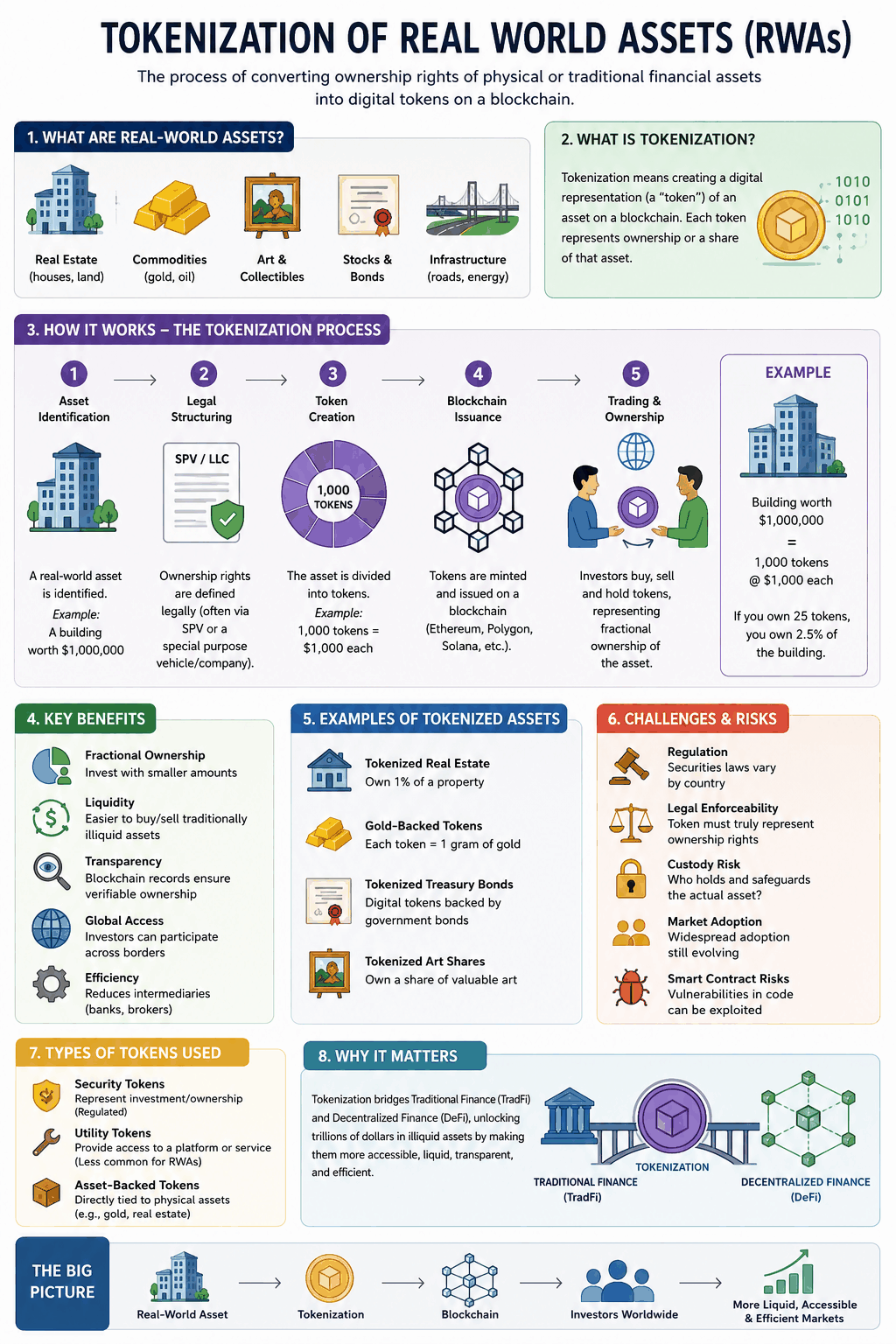
What can be tokenized
Categories of real asset.
In practice, three things can be tokenized in almost any asset: the asset itself, the rights attached to it, or the cash flows it generates. The third is often the cleanest.
Real estate
Buildings, land and development assets. Income-producing portfolios, hospitality and strategic land.
Metals & commodities
Gold, silver, platinum group metals, copper, zinc, aluminium, iron ore, lithium and other battery and critical minerals.
Energy
Natural gas and LNG, renewables, and the reserve economics and export rights attached to them.
Infrastructure
Energy networks, interconnectors, terminals, storage and strategic national infrastructure.
Shipping
Vessels, maritime infrastructure and the charter revenue streams they generate.
Financial & contractual rights
Debt, revenue rights, royalties, receivables and future cash flows.
How it works
Eight stages, in sequence.
A simplified account of tokenization has five steps: identify, structure, create, issue, trade. That is accurate but incomplete. Institutional execution separates validation from valuation, and issuance from administration, because those are the points at which transactions fail. Note where tokenization falls in the sequence: it is stage five of eight, and it can only represent a right that the four stages before it have established.
Identify
Identify a suitable real-world asset or economic right, and confirm it is capable of being carved out and transferred.
Validate
Independent technical, financial, ownership and legal verification by accredited third parties.
Value
Establish underlying asset economics and investable value on a documented, defensible basis.
Structure
Create the legal wrapper: asset into SPV, trust or issuer, with defined investor rights.
Tokenize
Digitally represent the applicable economic or ownership rights, with compliance logic embedded.
Issue
The appropriate instrument is issued through the relevant regulated or private route, by the entity authorised to do so.
Capitalize
Eligible investors provide capital against the instrument.
Manage & settle
Ownership, cash flows, distributions, transfers and reporting administered by regulated service providers through integrated infrastructure.
The sequence is not decorative. Each stage has hard dependencies on the one before it.
A token issued before the legal wrapper is final has to be reissued. An instrument marketed before valuation is documented gets repriced by the first serious investor who reads the data room. In regulated distribution, resequencing is not just inefficient — it has consequences with the competent authority.
Why tokenize
Transforming illiquid assets into programmable financial instruments.
Seven benefits worth claiming, described at the level of what actually changes.
- Capital formation
Create additional financing channels around existing or future economic value, alongside bank debt, equity and sovereign funding rather than in place of them.
- Fractionalization
Divide large economic exposures into appropriately sized investment units, opening assets to investors whose mandate size would otherwise exclude them.
- Global capital access
Connect assets to broader pools of qualified international capital, subject to eligibility and jurisdictional rules.
- Programmability
Encode eligible transfers, distributions, investor rights, lock-ups and reporting triggers so that administration follows the terms automatically.
- Transparency
Improve traceability of ownership and transactions, and shorten the distance between asset performance and investor reporting.
- Settlement efficiency
Use digital rails to compress issuance, transfer and settlement, including delivery-versus-payment against a payment token.
- Potential liquidity
Enable connection to appropriate secondary-market infrastructure where legally and commercially available. Liquidity is possible; it is not automatic.
Token structures
Four categories that are routinely confused.
The commercial label and the legal category are different things. Getting this wrong determines the wrong regulator, the wrong offering document and the wrong investor base.
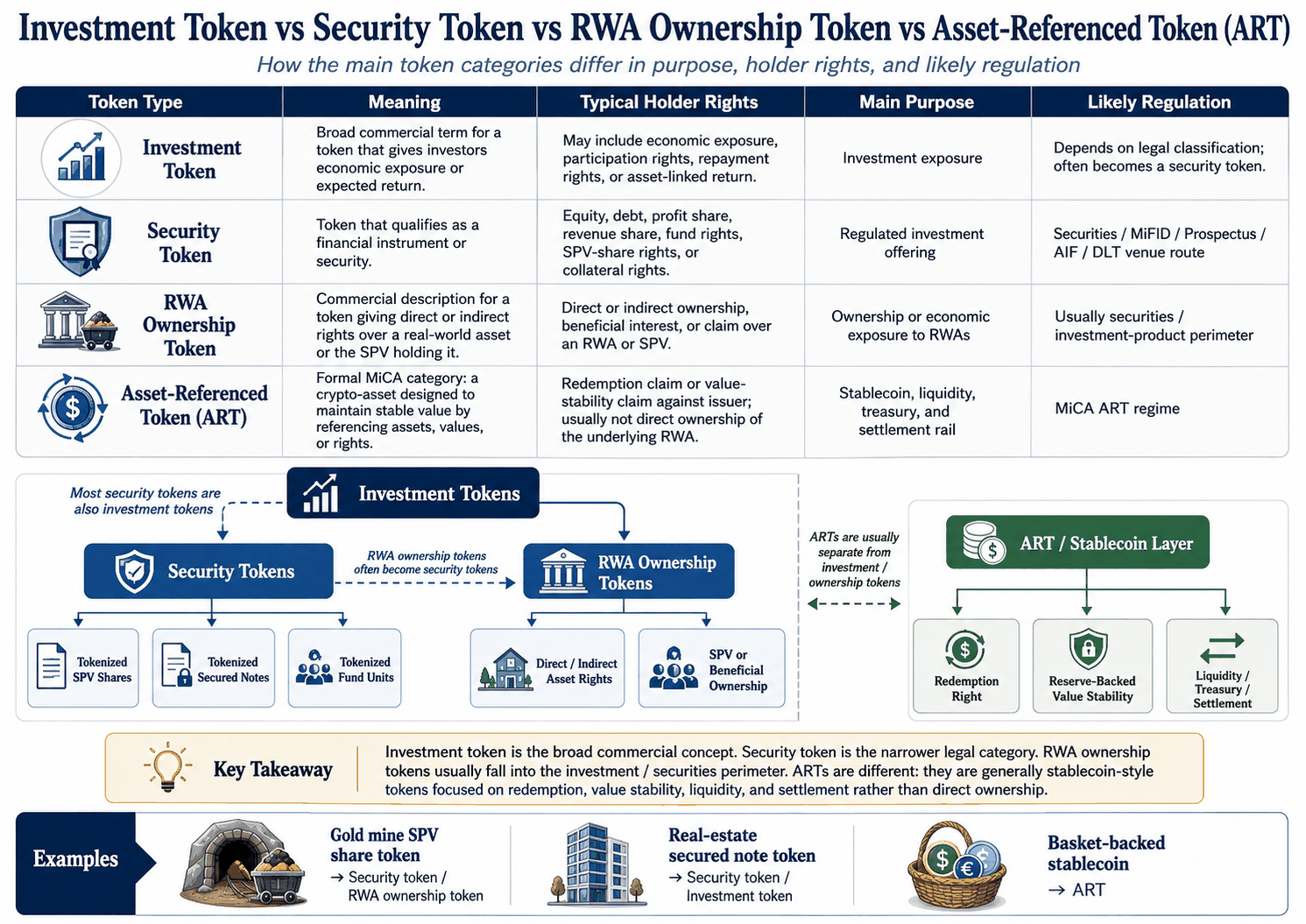
- Investment token
A broad commercial term for a token giving investors economic exposure or expected return. Classification depends on the rights actually granted; in practice it usually becomes a security token.
- Security token
A token that qualifies as a financial instrument. Equity, debt, profit share, revenue share, fund rights or SPV share rights, regulated through the securities, prospectus, fund or DLT venue route.
- RWA ownership token
A commercial description for a token giving direct or indirect rights over a real-world asset or the vehicle holding it. Usually sits inside the securities or investment-product perimeter.
- Asset-referenced token (ART)
A formal category under the EU markets in crypto-assets regulation (MiCA): a crypto-asset designed to maintain stable value by referencing assets. A redemption or value-stability claim against an issuer, not ownership of the underlying asset.
An asset-referenced token is not a tokenized asset.
Investment, security and RWA ownership tokens are about exposure to an asset. Asset-referenced tokens are about stability, redemption and settlement. They belong in different parts of the group structure, under different regimes, with different reserve and disclosure obligations. Conflating them is one of the fastest ways to lose institutional credibility.
The regime follows the classification, not the technology. In the European Union, MiCA governs crypto-assets but does not apply to crypto-assets that qualify as financial instruments. A token that is a security, a fund interest or another financial instrument is regulated under the securities framework — principally MiFID II and the Prospectus Regulation — and may be traded or settled under the DLT Pilot Regime where it is eligible. Most of what this page describes therefore sits outside MiCA.
Risks & governance
Disclosed properly, because the risks are real.
We publish the risk universe rather than a benefits list. It is a better filter for the counterparties we want.
Regulation
Securities and crypto-asset laws vary by jurisdiction and are still developing. Classification can change, and with it the permitted investor base and distribution route.
Legal enforceability
The token must genuinely represent the stated right, and that right must be enforceable against the vehicle in a real court, in a real jurisdiction.
Custody
Who holds and safeguards the underlying asset, the cash and the keys — and what happens on that provider's insolvency.
Market adoption & liquidity
Secondary markets for tokenized real assets remain thin. An instrument may be transferable in principle and illiquid in practice.
Technology & smart contracts
Code defects, key compromise, oracle failure and dependency risk in the underlying network.
Valuation
Real assets are appraised, not quoted. Reported values depend on assumptions that can move sharply.
For infrastructure and resource projects, the risk universe is wider still
- Geological risk
- Commodity price risk
- Construction and cost overrun
- Political and sovereign risk
- Regulatory and licensing
- Operational and safety
- Counterparty and offtake credit
- Currency and rates
- Environmental and social
- Sanctions exposure
Governance is what turns disclosure into discipline.
- Independent verification commissioned from accredited third parties, not produced in-house
- Segregation of asset risk through ring-fenced vehicles
- Separation of issuance, custody, administration and audit across different entities
- Investor eligibility and transfer restrictions enforced in contract and in code
- Defined reporting calendar with named responsible officers
- Smart-contract audit by recognised security auditors before issuance
Tokenbridge structures and coordinates. Regulated functions are performed by authorised partners.
Descriptions of capability on this page describe the group’s target operating model, not authorisations held. Regulated issuance, distribution, custody, administration, trading-venue and payment functions are carried out by entities or partners holding the relevant authorisations in the relevant jurisdiction. We will describe any authorisation only once it is actually held.
Start with the asset, not the token.
If you are holding a real asset and wondering whether any of this applies to it, that is the right question and the right time to ask it.