
Home / Asset classes / Energy & infrastructure
Energy & infrastructure
Tokenizing future economic value across the energy chain.
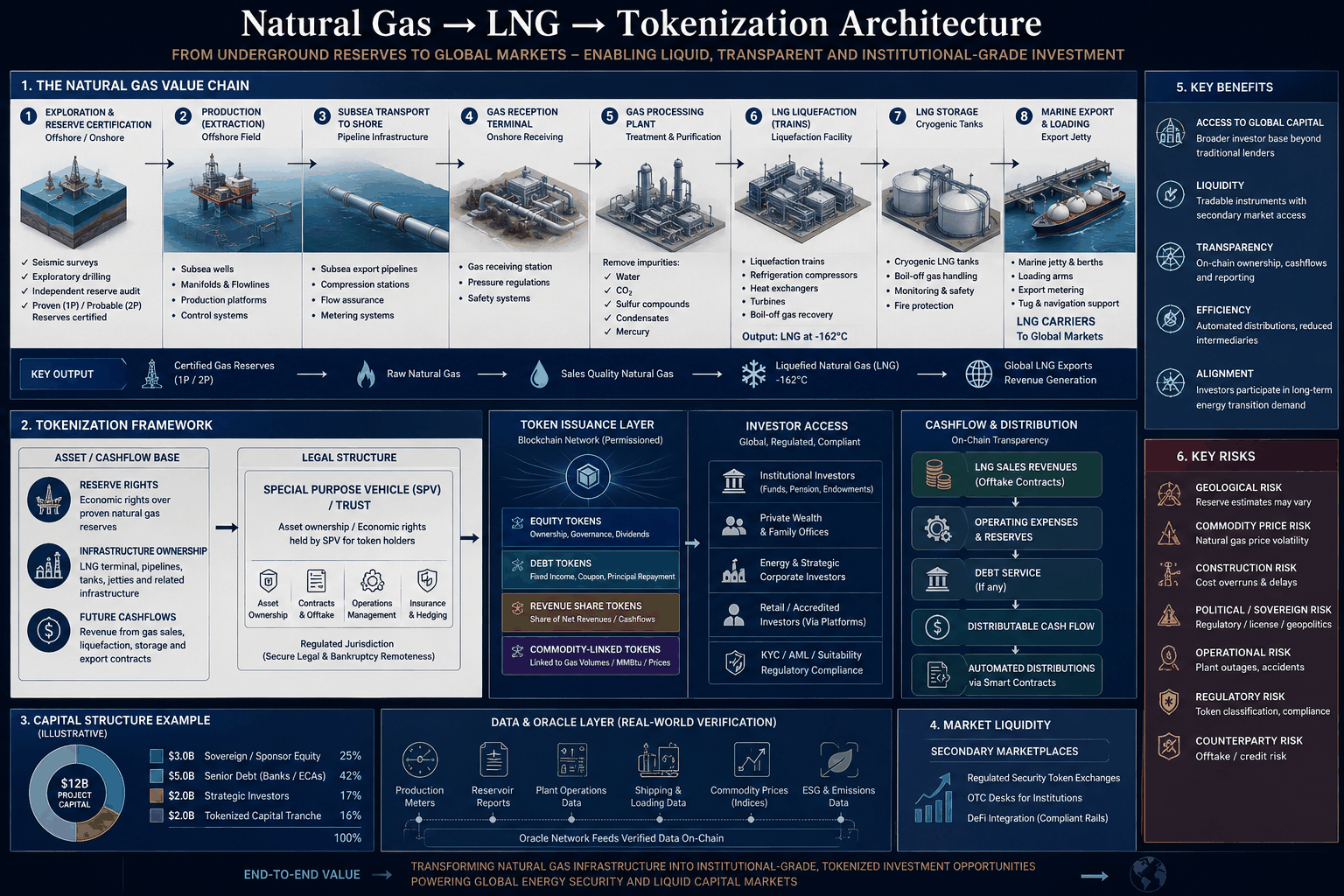
This is a materially more sophisticated form of real-asset tokenization than a single building. An energy project involves underground reserves, extraction rights, physical infrastructure, future cash flows, commodity markets and geopolitical exposure — energy infrastructure finance meeting digital capital markets.
What is actually tokenized
Three fundamentally different things.
The word tokenization hides an important distinction. These three have different legal characterisation, different risk and different investor bases.
Certified reserves & economic rights
Economic rights over independently certified proven and probable reserves, held through a vehicle. Comparable to reserve-backed structured finance and royalty trusts — and carrying the highest geological and political risk.
Physical infrastructure
Subsea gathering and export pipelines, compression, treatment, liquefaction trains, cryogenic storage, marine jetty and berths. Financed on terminal usage, storage, processing and loading fees.
Future production cash flows
Rather than the asset, the revenue it generates: revenue participation notes and securitised future receivables. Legally the cleanest of the three.
The value chain
From reservoir to global buyer.
Each stage creates a distinct financeable asset, and each stage retires a distinct category of risk.
Exploration & reserve certification
Seismic survey, exploratory drilling, independent reserve audit. Proven (1P) and probable (2P) reserves certified.
Production
Subsea wells, manifolds and flowlines, production platforms and control systems.
Subsea transport to shore
Export pipelines, compression stations, flow assurance and metering.
Gas reception terminal
Onshore receiving, pressure regulation and safety systems.
Gas processing
Removal of water, carbon dioxide, sulphur compounds, condensates and mercury to sales quality.
Liquefaction
Liquefaction trains, refrigeration compressors, heat exchangers and boil-off recovery. Output: LNG at approximately −162°C.
LNG storage
Cryogenic tanks, boil-off gas handling, monitoring and fire protection.
Marine export
Jetty and berths, loading arms, export metering, tug and navigation support to LNG carriers.
What can be financed
The financeable asset register.
Liquefaction reduces gas volume roughly six hundred times, which is what makes seaborne export economic — and what makes each element of the chain a separately financeable asset with its own revenue basis.
- Reserve economic rights over certified proven and probable reserves
- Subsea and onshore pipelines
- Gas processing and treatment plants
- Liquefaction trains and LNG terminals
- Cryogenic storage capacity
- Marine export infrastructure, jetties and berths
- Future offtake revenues under signed sale and purchase agreements
- Infrastructure debt across the construction and operating phases
- Revenue participation in net export proceeds
- Electricity interconnectors and grid connection rights
Structuring principle
Why we do not propose tokenizing raw sovereign reserves.
For a jurisdiction like Cyprus, the institutionally credible structure is not tokenizing raw sovereign gas reserves directly, but tokenizing future economic rights, infrastructure cash flows or LNG project-finance instruments.
Tokenbridge Global — energy positioningThat structure is cleaner legally, more bankable, and more compatible with regulated capital markets.
Token holders hold claims against a vehicle. The vehicle holds a carved-out economic right, an infrastructure interest or a revenue contract — not direct sovereign mineral title. That distinction preserves the state's ownership of its resources while still allowing the economic value to be financed, and it is the difference between a structure a pension fund can hold and one it cannot.
This principle governs how we position every sovereign energy mandate.
Risk universe
What an energy instrument actually carries.
Any offering document for this asset class has to be explicit about all of it.
- Geological
Reserve estimates are estimates. Recoverable volumes may vary materially from certified figures.
- Commodity price
Gas and LNG price volatility affects project economics and the value of every revenue-linked instrument.
- Construction
Cost overrun and delay are the norm rather than the exception on projects of this scale.
- Political & sovereign
Licensing, regulatory change and regional geopolitics, particularly in the Eastern Mediterranean.
- Operational
Plant outage, accident and unplanned maintenance affecting throughput and revenue.
- Regulatory
Token classification and the compliance burden attaching to the chosen instrument and distribution route.
- Counterparty
Offtake and credit risk where contracted revenue underpins the instrument.
Tokenbridge structures and coordinates. Regulated functions are performed by authorised partners.
Descriptions of capability on this page describe the group’s target operating model, not authorisations held. Regulated issuance, distribution, custody, administration, trading-venue and payment functions are carried out by entities or partners holding the relevant authorisations in the relevant jurisdiction. We will describe any authorisation only once it is actually held.
Discuss an energy or infrastructure financing.
We work with project sponsors, state entities, infrastructure funds and their banks on sequencing, structure and instrument design.