
Home / Digital finance
Digital finance
The rails that make a real-asset instrument work.
Infrastructure comes last, not first. An asset is validated, a right is carved out, a structure is built and capital is raised before any of this matters — and then the instrument has to be held, settled, paid and administered by institutions. Tokenbridge designs and coordinates that infrastructure; custody, settlement, payment and issuance functions within it are performed by appropriately authorised providers.
Tokenization platform
One operating core, four functions.
Asset onboarding
Origination workflow, document management, verification tracking and readiness assessment against the group’s structuring criteria.
Structuring & administration
SPV administration, instrument records, corporate actions and service-provider coordination.
Investor portal
Onboarding, eligibility and suitability, subscription, holdings, reporting and distribution history.
Registry & governance
The register of holders, reconciliation against the depository record, and a full audit trail.
Stablecoins & real assets
Connecting real assets with next-generation digital money.
Three models, presented in the order of increasing institutional durability. Select a model.
Model A — Direct asset-backed
Metal assets → reserve structure → stablecoin
- Intrinsic store of value
- Direct commodity backing
- Requires physical custody, allocation and audit
- Suited to premium reserve instruments
The token is backed one-to-one by allocated, custodied metal — gold, silver or a defined basket. Conceptually simple, operationally demanding: every unit issued must correspond to metal that exists, is allocated, is insured and is audited. Redemption mechanics and valuation of the underlying are the hard parts.
- 01Tokenized metal reserves
- 02Secure custody
- 031:1 backing
- 04Token issued
Model B — Fiat-backed with strategic metal support
Fiat reserves remain primary; metal assets provide additional support
- Fiat-backed and redeemable
- Metal assets as strategic contingent support
- Strengthens balance-sheet depth
- Improves resilience in stressed conditions
The reserve remains fiat. Metal assets sit behind it as contingent economic support where they can be legally structured to do so. This keeps the redemption promise simple while giving the issuer additional balance-sheet strength. The structuring question is what the metal support legally means to a holder.
- 01Tokenized metal reserves
- 02Contingent support framework
- 03Fiat reserves
- 04Token issued
Model C — Mining-finance enabled fiat stablecoin
Metal asset financing generates the fiat that backs the token
- Fully fiat-backed and redeemable
- Reserves generated from real-asset financing
- Scalable and regulatorily familiar
- Links the real economy to digital finance
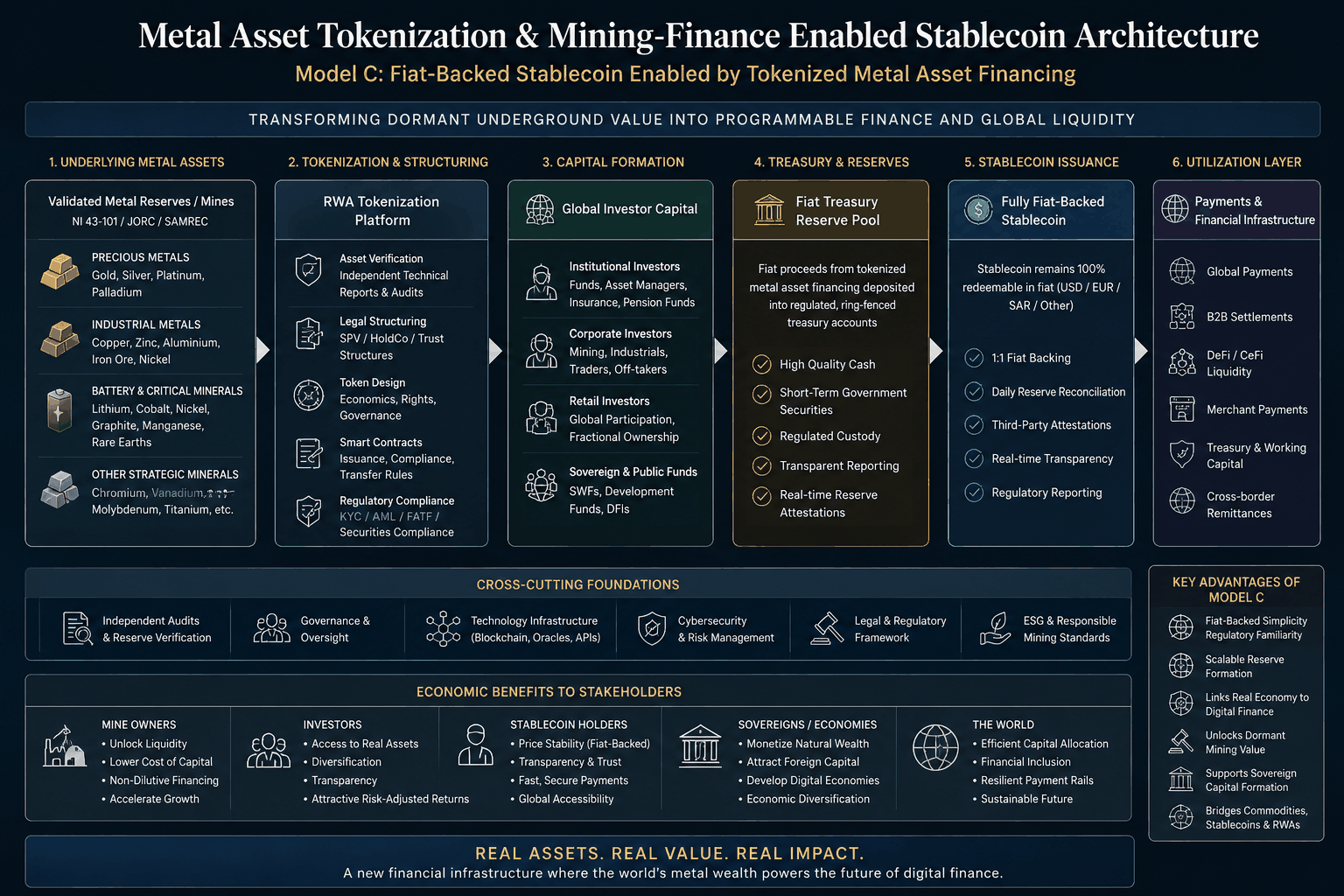
This is the differentiated architecture. The token remains fully fiat-backed — a conventional, well-understood reserve model. What differs is where the fiat comes from: proceeds raised by financing and monetizing validated metal assets are deposited into a regulated, ring-fenced treasury reserve pool that backs issuance. Metal-asset financing is the economic mechanism through which additional fiat capital enters the reserve and the wider ecosystem — it is not itself the backing.
- 01Validated metal reserves
- 02RWA tokenization & financing
- 03Institutional investment
- 04Fiat liquidity
- 05Treasury reserve pool
- 06Fiat-backed token
The stablecoin remains fiat-backed — and someone authorised has to issue it.
Metal-asset financing provides an economic mechanism through which additional fiat capital can be generated for the broader reserve and financial ecosystem. It does not make in-ground metal the reserve asset. Any issuance would be undertaken by a separate legal entity, under the applicable regime — in the European Union, MiCA, which is where that framework genuinely applies — with its own reserve, custody, attestation and redemption obligations — kept structurally distinct from the group's real-asset issuers.
In the EU this is a hard constraint rather than a preference. A token referencing a single official currency is an electronic money token, and MiCA requires its issuer to be an authorised credit institution or electronic money institution, subject to the applicable reserve, redemption and own-funds requirements. Tokenbridge is neither. Any such instrument would be issued by an authorised institution, with Tokenbridge structuring and coordinating around it.
Programmable finance
What programmability actually buys you.
Not novelty. Automation of things that are currently manual, slow and error-prone.
- Eligibility enforced at transfer
Only wallets holding a valid identity claim can receive the instrument, with jurisdictional restrictions applied automatically.
- Milestone-linked disbursement
Capital released against verified operational milestones rather than on a calendar.
- Automated distributions
Coupon, dividend and revenue-share payments calculated and distributed to the register of holders on a defined schedule.
- Lock-ups and vesting
Holding periods and transfer restrictions enforced by the instrument itself.
- Corporate actions
Conversion, redemption, buy-back and stabilisation mechanics executed against a single authoritative register.
- Reporting triggers
Threshold breaches and covenant tests surfaced from asset data rather than discovered at quarter end.
Payments & settlement
Treasury, settlement and capital flows.
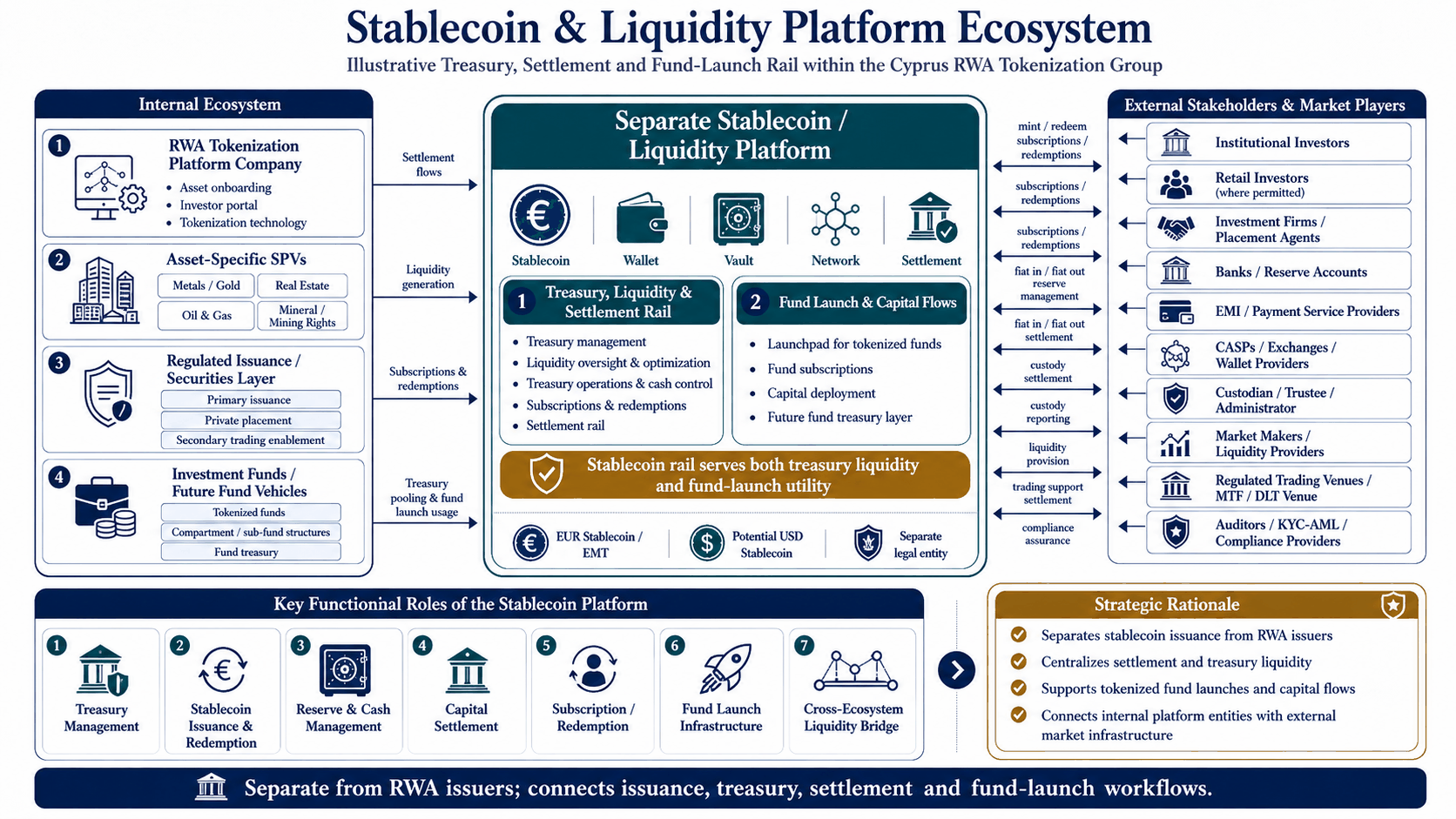
The liquidity platform sits deliberately apart from the issuers. It centralises settlement and treasury while keeping stablecoin issuance structurally separate from real-asset issuance. Payment, e-money and stablecoin issuance are conducted by entities holding the relevant authorisations.
- Delivery-versus-payment settlement of primary issuance and secondary transfers
- Subscription and redemption processing across instruments and vehicles
- Treasury and liquidity management across the group's vehicles
- Reserve and cash management with regulated custody and attestation
- Fund-launch infrastructure for tokenized fund vehicles and compartments
- A cross-ecosystem liquidity bridge between internal entities and external market infrastructure
Tokenbridge structures and coordinates. Regulated functions are performed by authorised partners.
Descriptions of capability on this page describe the group’s target operating model, not authorisations held. Regulated issuance, distribution, custody, administration, trading-venue and payment functions are carried out by entities or partners holding the relevant authorisations in the relevant jurisdiction. We will describe any authorisation only once it is actually held.
Discuss platform, treasury or settlement architecture.
We work with asset owners, governments, institutional investors and strategic partners.